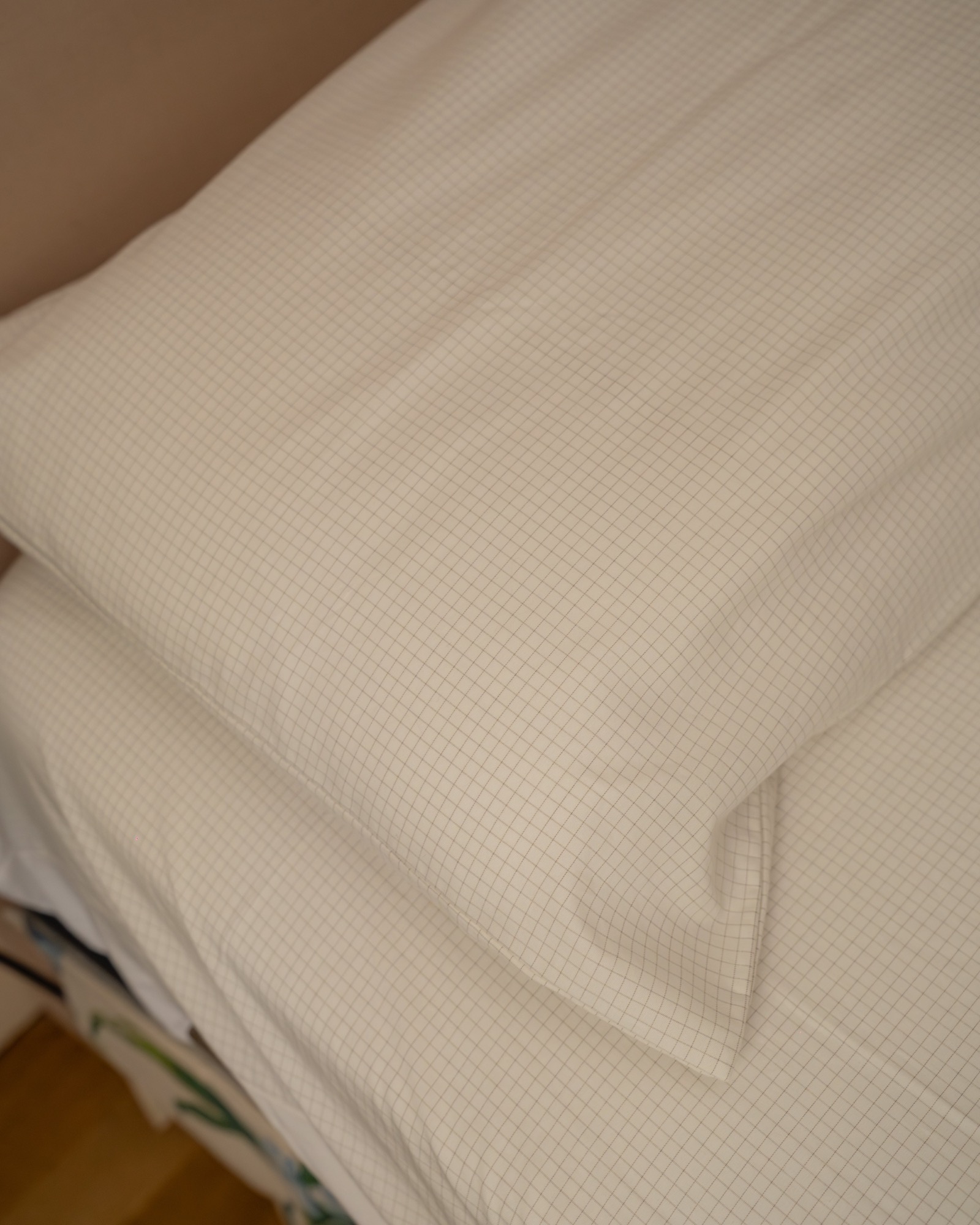
- There's no universal “yes” or “no”: what users describe most often is gradual, subjective change in sleep and rest — never a cure.
- No study establishes how long it takes to notice a change in sleep: everyone experiences it differently. Chevalier (2010) measured physiological changes during a single session of around 40 minutes, in a small sample.
- For sleep, the evidence in people is preliminary: a 12-participant pilot without a control group (Ghaly & Teplitz, 2004) and a single Korean trial with a mat and a placebo group (Park et al., 2025), not replicated. We explain it in grounding and sleep: what the studies say.
- When someone “doesn't notice anything”, there's almost always one of three causes behind it: a setup with no real earth, a product that has lost conductivity, or an expectation of a cure.
- Every study cited here works with small samples: these are observed patterns, not promises of an individual result.
What does it mean for grounding to “work”?
Direct answer: grounding isn't a drug or a medical treatment — it's a low-risk supporting habit, with no batteries and no side effects reported in the available literature. “Working” here means noticing gradual, subjective changes (sleep, relaxation), not an instant or guaranteed cure for anyone.
This distinction matters because it completely reframes what you should expect from using a grounding sheet. It isn't a medical device that “fixes” something broken: it's a practice aimed at reconnecting the body to the earth during sleep, passively and consistently. The available studies — which we won't unpack in depth here — point to measurable physiological changes in certain markers (cortisol, muscle tension) and in perceived rest across samples of participants, but no serious study presents it as a treatment for a diagnosed disease. If you want to dig deeper into what the science actually says about grounding, including study methodology and its limits, we have a dedicated article on that — here we're focusing on the practical experience of using it, not academic rigour.
If your expectations are already calibrated and what you want is to rule out the first two causes of a “nothing happened” — the setup and the quality of the fabric — this is the sheet you can check that with yourself.
View the Grounding SheetHow long does it take to notice grounding?
Direct answer: there's no guaranteed timeline that's the same for everyone, but user accounts (not studies) tend to split into two scenarios: sleep and general wellbeing (1-2 weeks of continued use, according to those accounts) versus relaxation or muscle-tension effects within a single session of around 40 minutes (Chevalier, 2010). These are observed patterns, not individual promises.
For sleep and subjective wellbeing, the pattern that shows up most often in user accounts is a gradual one: not the first night, but after several nights of continued use, which those accounts often place at one to two weeks. That's a user experience, not a study finding. As for the studies, Ghaly & Teplitz (2004), published in the Journal of Alternative and Complementary Medicine, measured cortisol and collected self-reported sleep from 12 participants, without a control group — a preliminary pilot, not independently replicated, that doesn't establish any timeframe and shouldn't be read as a guarantee.
For short-term relaxation or muscle-tension effects, some preliminary studies point in that direction: Chevalier (2010), published in the Journal of Alternative and Complementary Medicine, measured changes in heart rate, breathing, blood oxygenation, and skin conductance during and after a single 40-minute grounding session, in a small sample of participants. Again: that's the pattern reported by that specific study, not a promise that the exact same thing will happen to you, in that exact timeframe.
The most honest thing we can say is this: there's no established timeframe, so neither a few nights nor several weeks guarantees noticing a change. If you've been using the sheet for a while and haven't noticed anything, it's worth reviewing the causes we explain below before drawing conclusions.
What level of evidence is there for each use?
Direct answer: in no area is the evidence conclusive. For sleep there's a pilot without a control group and a single trial with a placebo group, not replicated; for inflammation and chronic pain, early-stage studies with small samples. This isn't a promise of results: it's what the currently available studies report, limitations included.
| Area | Level of evidence | What the cited studies report |
|---|---|---|
| Sleep and subjective wellbeing | Preliminary, not replicated | Ghaly & Teplitz (2004): cortisol measured and sleep self-reported, no control group. Park et al. (2025): trial with a mat and a placebo group, results as reported by its authors |
| Blood viscosity / circulation | Preliminary, finding replicated in a small sample | Chevalier et al. (2013): reduced blood viscosity in participants |
| Inflammation / chronic pain | Early-stage, small samples | Oschman, Chevalier & Brown (2015), Journal of Inflammation Research: hypothesis on reducing inflammatory markers, pending larger studies |
| General physiological effects | Preliminary | Chevalier (2010): changes in heart rate, breathing and skin conductance during and after a 40-minute grounding session |
Chevalier et al. (2012), in their review published in the Journal of Environmental and Public Health, gathers several of these findings and, together with the studies above, forms the basis of what's formally known about grounding from a scientific standpoint today. We won't repeat the analysis of that evidence here, nor its methodological limitations, nor the debate around conflict of interest in some of these studies — that's covered with the rigour it deserves in our article on whether grounding is real or placebo. What we do want to make clear here is the practical implication: with the evidence available today, none of these areas allows you to expect a specific result, sleep included: the two studies that measured it are preliminary and haven't been independently replicated.
“My grounding sheet doesn't work, I don't notice anything” — the 3 real causes
Direct answer: when a user notices no change after several weeks of use, there's almost always one of three causes at play: a set-up without a genuine earth connection, a low-quality product that's lost conductivity, or an expectation of a “cure” rather than a “supporting habit.” Identifying which one applies to you is far more useful than concluding that “grounding doesn't work.”
Cause 1 — a set-up without a genuine earth connection. The grounding sheet needs to be connected, via its cable, to a socket that's genuinely earthed. If your home's wiring lacks an effective earth connection (more common than you'd think in older electrical installations), or if you're using a travel adaptor or power strip that breaks that connection, the sheet can be perfectly conductive and still transfer nothing. Without a real earth, there's no circuit — no matter how good the product is. This cause is the easiest to overlook, because the product “looks” properly set up at a glance.
Cause 2 — a low-quality product that loses conductivity. Not all grounding sheets are made equal. Low-density or poorly woven silver thread can lose a large part of its conductive capacity after relatively few washes, even when care instructions are followed. If you suspect this is your case, we have a practical guide on how to check with a multimeter whether your sheet is still conducting — the most direct way to rule this cause in or out without guessing.
Cause 3 — expecting a “cure” instead of a “supporting habit.” This is probably the most common cause, and the hardest to recognise. If someone starts using a grounding sheet expecting a diagnosed chronic pain condition, a serious health issue, or any medical condition to disappear, it's understandable they'll feel it “doesn't work” — because grounding never promised that. It's a low-risk habit designed to support general wellbeing, not to treat a disease. Setting the right expectation from the start avoids this frustration, which often has nothing to do with the product itself.
What real users say (and why experiences vary so much)
Direct answer: real user experiences are mixed by design, not by coincidence: some people describe improvements in their rest, others notice nothing at all, and the difference usually comes down to the set-up, the product's quality, or the goal they had when they started using it — rather than the concept of grounding itself.
We've gathered and organised what real users say on Reddit and various forums about their experience with grounding sheets, both positive and negative, without filtering out or dressing up the sceptical opinions. That contrast in experiences isn't a flaw in the concept — it's exactly what you'd expect from any wellbeing habit that depends on consistency, correct set-up, and individual variability between people. Someone who sets the sheet up incorrectly, or expects results within two nights, or is hoping to resolve a diagnosed chronic pain condition, is far more likely to feel that “it doesn't work” than someone who uses it consistently, sets it up properly, and keeps expectations aligned with what the available evidence suggests.
The limits of the evidence
Direct answer: grounding isn't a guaranteed promise for everyone — the evidence is preliminary on every front and based on small samples, and individual experience varies. We say that here with full transparency, not hidden away.
We want to be transparent: grounding isn't a guaranteed promise for everyone. The available studies explore several fronts —sleep, blood viscosity, perceived wellbeing— but most of them work with small samples, and larger, independent studies are needed to find out whether these effects hold up and how large they are. Individual experience varies, and it's more honest to acknowledge that than to hide it. If, after reading this, you decide you'd like to try it, here's how the most sought-after grounding sheets of 2026 compare, in case it helps you choose with a clear head before buying.
Conclusion
Grounding, applied through a sheet during sleep, has user accounts of improvements in rest and scientific evidence that is still preliminary, for sleep as much as for pain and inflammation. When someone doesn't notice anything, it's worth ruling out three identifiable causes first: set-up, product quality, or expectations of a cure. These are variables that can be identified and corrected, although correcting them doesn't guarantee any result.
If after reading this you'd like to try it with a product that's transparent about set-up and conductivity testing, you can check out Vitality's silver grounding sheet, designed to rule out precisely the first two causes of “it's not working”: a clear set-up with cable and continuity certificate included, plus silver as the conductive material.
Frequently asked questions (FAQ)
Founder of Vitality Life Balance and BioWell (bioquantum) accredited. He has spent years testing and measuring grounding equipment, and writes based on the published grounding studies, limitations first. He is not a healthcare professional: this content is informational and does not replace medical advice. You can read his story here.
References and sources
- [1] Ghaly, M. & Teplitz, D. (2004). The Biologic Effects of Grounding the Human Body During Sleep as Measured by Cortisol Levels and Subjective Reporting of Sleep, Pain, and Stress. Journal of Alternative and Complementary Medicine, 10(5), 767-776.
- [2] Chevalier, G. (2010). Changes in Pulse Rate, Respiratory Rate, Blood Oxygenation, Perfusion Index, Skin Conductance, and Their Variability Induced during and after Grounding Human Subjects for 40 Minutes. Journal of Alternative and Complementary Medicine, 16(1), 81-87.
- [3] Chevalier, G., Sinatra, S.T., Oschman, J.L., & Delany, R.M. (2013). Earthing (Grounding) the Human Body Reduces Blood Viscosity—a Major Factor in Cardiovascular Disease. Journal of Alternative and Complementary Medicine, 19(2), 102-110.
- [4] Oschman, J.L., Chevalier, G., & Brown, R. (2015). The effects of grounding (earthing) on inflammation, the immune response, wound healing, and prevention and treatment of chronic inflammatory and autoimmune diseases. Journal of Inflammation Research, 8, 83-96. PMC4378297
- [5] Chevalier, G., Sinatra, S.T., Oschman, J.L., Sokal, K., & Sokal, P. (2012). Earthing: Health Implications of Reconnecting the Human Body to the Earth's Surface Electrons. Journal of Environmental and Public Health. DOI: 10.1155/2012/291541